

How interactive technology can invite audiences into unexpected art experiences
Jim Horsfield has co-run As Described with business partner Adam Seaman since 2007. Their company’s tag line is ‘We make stuff happen with video’; and work can involve filming, post-production and projection. Jim’s journey with creative video projection began with in nightclubs where he would match video clips live in time with the music, a practice that became known as VJing. As Described went on to manage large scale video installations for festivals such as The Big Chill, and have toured with various music artists including John Hopkins, Global Communication, Portishead, and Beardyman. In the majority of this work, they create original video content as well as mixing clips live on stage to compliment the music as it is performed.
Can you tell us about a project you’ve worked on where accessibility played a key role?
A few years ago, we took some of the ideas from the set ups we had used on stage to create an interactive video installation called Geminate. Although this was an arts council funded project, it was not inherently designed with accessibility in mind, we just wanted to make a great project that anybody could take part in. We were given the opportunity to create an installation within the shop front of an old department store.
To make it interactive we brought in a couple of bits of infra-red technology; starting with Kinect cameras. The benefit of this type of camera is that you can specify the distance at which the camera responds. So the camera picks out the highlights of a human shape but not the whole background. In the installation we took these cameras and put them pointing outwards from the shop front onto the street. As people walked past, the cameras would pick up the human form, not the fine details of the face, but the outline. This was projected onto a huge screen in the shop window in real time, using custom code to adjust the moving images to give them different styles and looks.
Because people didn’t have to physically do something, like touch a button, anybody could be involved. We didn’t actually publicise what it was and what it was doing, so it was very much put out there as a play thing. What we found was, people walked past it and were intrigued, then they would walk back and realise ‘that’s me!’ Then you started to see people playing and discovering. It was really appealing because there were no rules, there were no restrictions to people taking part. As long as they could move past this space; on foot, on a bike or in a wheelchair, there were no barriers to being involved. In one iteration of the project, we set up a simultaneous installation in a town in France, and streamed the broadcast from one location to the other. So you could have someone in France waving, and someone in Ipswich waving back.
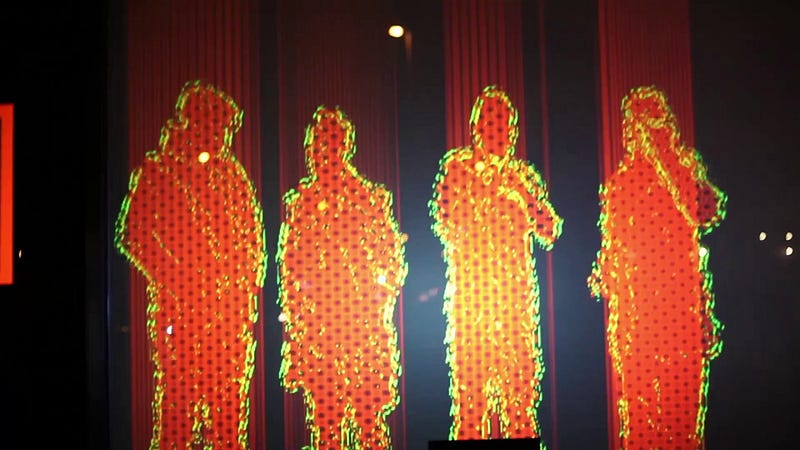
In another version of the project, we added a leap action controller. This allows you to set specific responses to happen based on a particular type of movement trigger. We put the leap control pad on the window in the image of a hand. Around the border of the hand shape was red, and we set the outline to light up in green when people’s hands were close enough, so without any specific instructions they were able to work it out. We had it so that if you twisted your hand one way, it ‘flanged’ the sound. When you twisted it the other way, it put this crazy effect on the made the whole thing disappear.
It was great, people could walk past and discover it, and they were actually seeing art on the street. They didn’t have to physically walk through a door and past a gallery assistant, which can feel a bit intimidating.
In your view what part does technology have to play in making performing arts more accessible?
If you have infrared cameras of some kind, or motion controllers, you can really make things accessible and invite people to participate. From a performance standpoint, there’s no reason why you couldn’t position these things around the stage and allow people with limited movement or communication to participate in a performance. Just a small action could trigger another event, which could then lead on to telling a story somehow. This technology could also be used to trigger subtitles for example, or transitions between scenes. There’s so much you could do, there’s no limits nowadays apart from budget.
Another other angle is looking at how 4-D cinema, sound vibrations etc might increase accessibility for the hard of hearing and deaf communities. Could you use vibrating chairs for theatre audiences? I think it will be great to see what VR could offer too.
So the possibilities are endless?
Yes, they really are, but we need to test these things out. One thing I am really interested in is that often when one sense doesn’t work as well the others become more heightened. I’m wondering for example whether binaural sound might be really intense for visually impaired audiences. It would be interesting to find out what intensity these effects need to be at before they provide too much information for people to process. Strobe lighting is taken out of performances to make them more accessible for sensitive audiences, and audio should be a consideration as well.
Can you think of any recent technological advances that might have an impact in this area?
Open Sound Control (OSC) is a way of opening stuff up so you can design an interface on an iPad to suit somebody’s accessibility needs. An iPad can’t generate MIDI, but it can generate OSC that can then be turned into MIDI and used to trigger anything from sound, to video and movement.
I think the more this type of stuff becomes available the more it will open doors for people who would not necessarily have access to the creative industries. Once they can master the technology the possibilities are endless. The technology enables the creativity but the thought process behind the tool just becomes second nature.
What does the term ‘integrated accessibility’ in the performing arts mean to you?
To me, it means that at the core of the project there must be an understanding of the abilities of all the people of involved, and steps taken to ensure that that there are no barriers to their entry into that performance. Everybody’s good at something, so how can we incorporate that? Here are their skills, let’s make the best of them and bring them into the performance. It’s about focusing on what people can do.
In your view, in what other ways could performing arts be made more accessible for performers and audiences?
I think there needs to be a whole shift in thinking, from this is not a ‘special’ performance to this just is the performance. And there’s a whole mindset that will need to change for that to happen. You’ve got to be aware of the fact that there are issues, but why should the issue be pushed to the forefront and made part of the branding of the piece? It needs to be part of the marketing, but not necessarily part of the aesthetic. I would love people to just be accepted for who they are, not what they are presenting as in a physical form.
What are the key challenges facing artists trying to integrate accessibility within their creative practice?
It’s that fine balance of positive discrimination and normalisation. It’s about removing barriers to entry; there needs to be an understanding that people may need extra help to access things but that’s ok.